
Federal Release Chain Near New Kent
The federal route has three main record owners. Pamunkey Regional Jail may hold a person in a contract bed. The U.S. Marshals Service manages many federal pretrial, court-transport, and designation movements. The Bureau of Prisons manages sentenced federal custody and supplies the national inmate locator. No standalone federal prison was identified in New Kent County, and PRJ must not be described as one.
A published USMS and PRJ agreement authorizes specified federal detention at the regional jail. It covers federal pretrial detainees, people awaiting BOP designation or transport, and certain immigration proceedings. The agreement is evidence of an allowed placement route. It does not prove that a named person is there now.
The custody flow may be: federal arrest or court commitment → USMS placement at PRJ → federal court or another contract jail → BOP designation after sentence → BOP release or another lawful handoff. Each arrow is a record event. Only the last verified community-release event should be called freedom from custody.
Federal Release From PRJ
The agreement contains a decisive local rule. PRJ may release a federal detainee only to the committing federal agent or a Deputy U.S. Marshal. Thus a federal name disappearing from PRJ's “Who's In Jail” list can reflect a marshal pickup, court movement, another contract placement, or transport toward BOP custody. It cannot be treated by itself as a community release.
Call PRJ Booking/Release at 804-365-6400 extension 3043 or Records at extension 3033 and ask whether PRJ custody ended, when it ended, and whether the receiving authority was federal. Ask for the existing custody-history entry or release/transfer form rather than an opinion about where the person is now. If the response identifies USMS, continue with the docket and federal records route.
PRJ is at 7240 Courtland Farm Road, Hanover, VA 23069, outside New Kent. The jail's public hours are 8 a.m. to 5 p.m. on weekdays. Those contact facts support a local record inquiry. They do not make the regional facility a BOP prison or public USMS booking office.
Search Federal BOP Release Records
The BOP Inmate Locator covers federal inmates from 1982 forward. Search by BOP Register number, DCDC number, FBI number, or INS number. A name search requires first and last name, with optional middle name, race, age, and sex. Identity numbers are preferable when common names or aliases could cause a false match.
- Choose the number search when a federal register or other accepted ID is known.
- Otherwise enter the exact name and use optional filters only when the facts are reliable.
- Compare the name, register number, age, race, sex, release date, and location shown in the result.
- Read “Released,” “Not in BOP Custody,” “In Transit,” “Unknown,” and any future date according to BOP's published meanings.
- Check the federal docket or another custodian when BOP status does not answer the full custody question.
The BOP record explanation says “RELEASED” means the person is no longer in BOP custody. That is strong evidence about BOP custody only. It does not rule out state custody, immigration custody, another sovereign's detainer, or federal supervised release. A future date is projected and can change. “UNKNOWN” means the term is not yet determined, while “IN TRANSIT” has limits that make a specific location uncertain.
The official BOP locator interface shows the distinct number and name search paths.
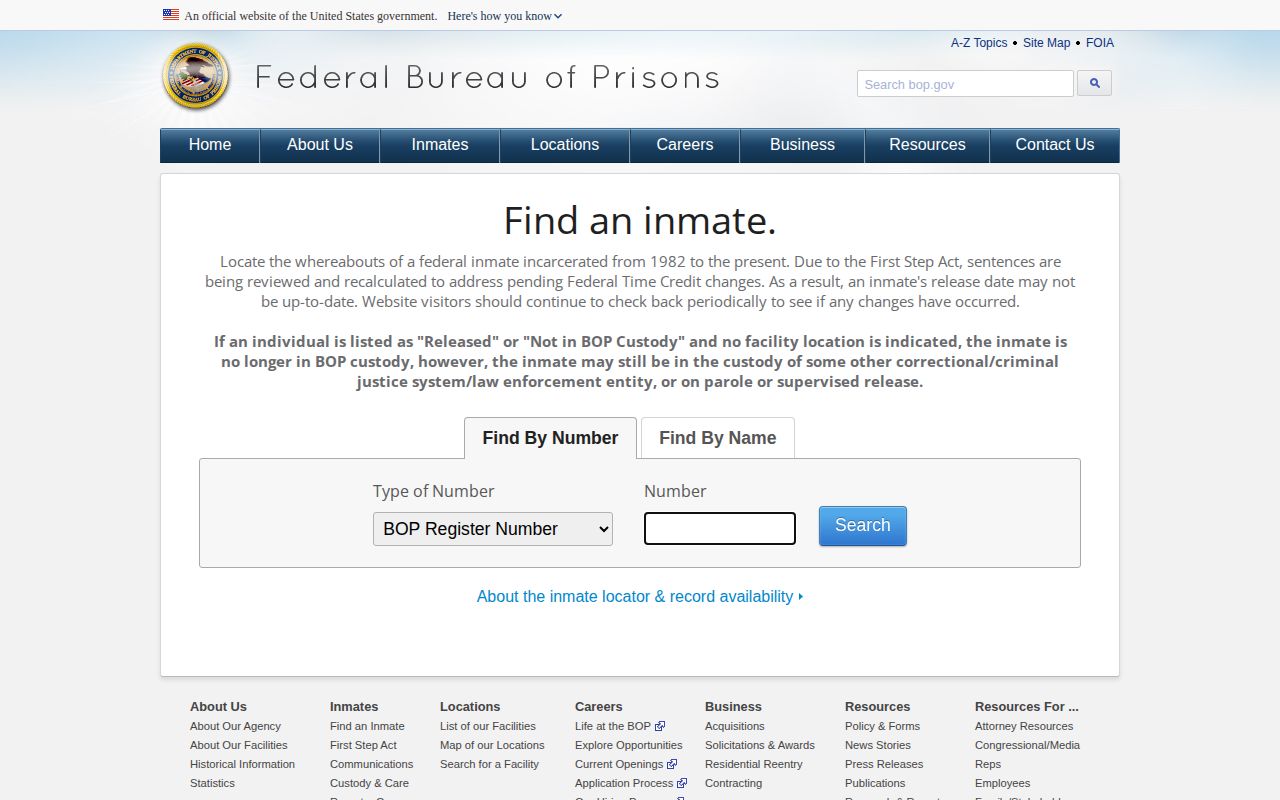
That screen belongs to sentenced federal custody research. A PRJ or USMS pretrial placement may not yet produce the BOP result a reader expects.
Read Federal Release Results Carefully
BOP result fields answer bounded questions. The Release Date can be a past actual date or a future projected date. Location may show an institution or a released status. Register number provides a stable federal identifier. None of those fields supplies the full New Kent arrest history or PRJ transfer time, and none proves that every form of custody ended.
| Source | What it can confirm | What it cannot prove alone |
|---|---|---|
| PRJ record | Local admission, custody end, federal pickup field | End of later federal custody |
| Federal docket | Detention, release, sentence, or court order | Exact transport and door time |
| USMS record | Pretrial or transport custody event | BOP sentence completion without BOP data |
| BOP locator | BOP location, release date, BOP-specific status | Custody held by another authority |
For records before 1982, BOP directs researchers to the National Archives with identifying information and approximate prison dates. For a modern case that never reached a BOP sentence, the federal docket and USMS route may remain the main sources. Keep the case number, register number, and PRJ inmate ID separate because they belong to different systems.
Note: “Not in BOP custody” describes BOP's scope and should not be rewritten as proof that no government authority holds the person.
USMS Pretrial Release Records
USMS has no public nationwide historical release locator comparable to BOP's tool. Federal pretrial status is usually best researched through the case docket first. A detention order, release order, sentence, designation step, or later court action can identify the legal basis for movement. PACER is the federal judiciary's docket access route, but the court entry still may not show the exact time a marshal or contract jail completed transport.
A docket can also show why a person never appears in the BOP sentenced-custody search. A pretrial release, dismissal, time already served, or a placement still controlled by USMS may end or change detention without a normal prison designation. Conversely, a sentence can be entered before the person reaches the assigned BOP institution. Read the sequence of detention, sentencing, commitment, and release orders, then compare it with the PRJ and marshal dates. The legal case timeline and the physical transport timeline may move at different speeds.
For the custodial event, make a focused USMS FOIA or Privacy Act request as appropriate. Identify the person, court, case number, approximate date, and PRJ placement if known. Ask for existing records that show when USMS custody or a particular placement began or ended, and the next custodial disposition when releasable. Do not ask USMS to create a narrative that reconciles every agency.
Pretrial and transport: U.S. Marshals Service
Sentenced custody: Bureau of Prisons
Legal authority: federal court docket
Local contract event: Pamunkey Regional Jail Records
The New Kent County release record overview explains the parallel county, state, and federal paths. Use that broader route when a federal case intersects with a New Kent arrest or court matter.
Federal and ICE Custody Differ
Immigration detention is a federal civil custody track, but it is not the same as a BOP sentence. The older PRJ agreement includes certain immigration-related language. The research did not find a current ICE facility listing that proves routine ICE use of PRJ. Do not turn contractual authority into a claim that New Kent or PRJ presently operates an ICE detention center.
If a PRJ record indicates an immigration pickup, search ICE's Online Detainee Locator with an A-number and country of birth, or the exact recorded name and country of birth. A local jail departure on an ICE detainer is a transfer into immigration custody. The separate ICE Detention Chain page covers the locator's limited recent-release window and no-result reasons.
- Pretrial detention
- Custody before the federal criminal case is finally resolved.
- Designation
- The BOP process of assigning a sentenced person to a federal institution.
- Supervised release
- Federal court supervision after imprisonment. It is not the same as BOP confinement.
- Detainer
- A request from another authority to receive or hold the person after one custody stage.
Best Federal Release Evidence
A strong conclusion joins the right records in time order. For a PRJ federal placement, begin with the jail custody-end record and its receiving-agency field. Add the federal court order that supplied legal authority. Use a USMS record for the pretrial or transport stage and BOP's official release result for sentenced custody. If the last record shows a detainer or ICE transfer, continue into that system.
Do not collapse projected, ordered, and actual dates. A judge can enter a release order before the physical handoff. BOP can display a projected date that later changes. PRJ can end its own custody while USMS custody continues. When sources conflict, compare the observation time and each source's jurisdiction, then ask the owner of the disputed field for correction or clarification.